115 Views
The Oil War Washington Can’t Win: Inside Venezuela’s Fight for Sovereignty
The United States has always had one core strategic obsession: energy. Throughout modern history, Washington has sought to guarantee the unrestricted flow of oil and gas and ensure that no global power or region gains the ability to control that flow. While the Middle East hosts the bulk of the world’s hydrocarbon reserves and has long been a playground for American intervention, coups, and engineered instability, South America — particularly Venezuela — also carries immense strategic weight as the world’s largest holder of proven oil reserves.
Beyond oil, Venezuela is rapidly transforming into a key player in other critical resource markets, especially gold. In response to extreme volatility in oil revenues, the country has increasingly turned to gold extraction as an alternative source of income. And although Venezuela is not a major producer of lithium, its proximity to the “Lithium Triangle” of Bolivia, Argentina, and Chile offers it potential strategic leverage in the future.
Washington has long treated Venezuela as a vital energy asset, shaping its political, security, and economic policies to secure influence and control. The strategies pursued under Trump are, in fact, extensions of the neoliberal policies of the 1980s designed to preserve U.S.-led global capitalism.
Before the nationalization of Venezuela’s oil industry in 1976, U.S. oil corporations not only operated freely in the country but effectively controlled its resources. Nationalization drastically reduced America’s influence over Venezuela’s energy sector. The next turning point came in 1999 when Hugo Chávez rose to power with a nationalist, anti-imperialist agenda. Chávez brought the country’s oil resources firmly under state control, reduced drilling investment, dismissed a significant number of engineers and geologists from the national oil company, and simultaneously rallied OPEC states to restore discipline to global oil markets. Though output declined, rising prices boosted national revenues.
Since 1999 and the emergence of Chávez’s Bolivarian Revolution, relations between Caracas and Washington have deteriorated into a deep, multi-layered crisis driven by ideological conflict between 21st-century socialism and American liberal democracy, competition over the world’s largest oil reserves (303 billion barrels), the political isolation of the Maduro government, large-scale narcotrafficking networks, and the geopolitical rivalry of major powers.
For nearly two centuries, the U.S. has sought to keep Venezuela in its sphere of influence — from the Monroe Doctrine (1823) to more than 42 direct and indirect interventions. But nationalization policies under Chávez in 2001, along with the Hydrocarbons Law (which allocated 80 percent of revenues to the state), pushed relations beyond repair. The failed 2002 coup, openly backed by the CIA, strengthened Venezuela’s anti-U.S. alliances with Cuba (100,000 barrels of oil per day), Russia (12 billion dollars in arms, including Sukhoi-30 jets and S-300 systems), and China (60 billion dollars in loans tied to oil). Caracas transformed into a fortress resisting U.S. influence in America’s own traditional “backyard.”
The extensive sanctions launched by the Trump administration in 2017 (Executive Order 13808), continued under Biden, and reinforced after Trump’s return in 2025, devastated Venezuela’s economy. Oil exports plunged from 2.2 million barrels per day (2016) to just 370,000 (2024).
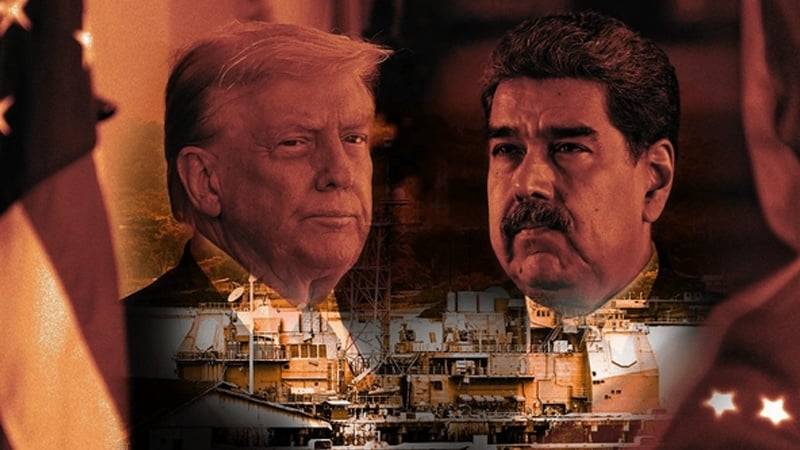
With Trump back in office in 2025, tensions escalated to a military level. Trump labeled Nicolás Maduro “the leader of the world’s largest drug cartel.” Beginning in September 2025, the U.S. launched Operation Caribbean Shield: drone and naval strikes against boats allegedly tied to drug trafficking, killing 61 people. The USS Abraham Lincoln carrier strike group — four destroyers and sixty F-35 fighters — was deployed to the Caribbean. By October, Russian Kilo-class submarines and S-400 missile systems appeared on Venezuela’s La Orchila Island. In November, B-1 bombers were moved to Guantánamo Bay. Trump denied involvement, but the Pentagon confirmed it.
In response, Venezuela passed an anti-terrorism law that strips citizenship from anyone aiding U.S. military actions. Maduro requested Kalibr cruise missiles from Russia, Wing Loong drones from China, and military advisers and drones from Iran. Despite 200 percent inflation, 7.7 million migrants, and 85 percent of the population living in poverty, Venezuela survives through oil exports to China and strategic assistance from Russia.
On October 7, Trump ordered the termination of all diplomatic contacts with Caracas and authorized the CIA to begin covert operations inside Venezuela. On October 15, he publicly acknowledged authorizing clandestine CIA activity but refused to say whether assassination plans against Maduro had been approved. Maduro has repeatedly stated that Venezuela faces the most serious threat of U.S. invasion in a century. Washington accuses Caracas of insufficient efforts to combat narcotrafficking and uses this claim to justify a growing U.S. military presence in the Caribbean.
Over the past few months, U.S. forces have carried out at least 21 strikes on Venezuelan coastal areas. Maduro has condemned the attacks and insists that Venezuelans will defend their homeland. He described the past 22 weeks as “psychological terrorism” imposed by the United States.
As U.S. naval forces expand their presence around Venezuela and drone strikes against boats allegedly carrying narcotics continue — often with high casualty counts — tensions escalate further. In a recent speech in Caracas, Maduro declared that Venezuela rejects a “slave’s peace,” accusing Washington of testing the country militarily for nearly six months. He emphasized that Venezuela wants peace, but peace based on sovereignty, equality, and freedom — not foreign coercion.
Trump, however, seeks Maduro’s removal and full U.S. access to Venezuela’s energy reserves.
Ultimately, the guiding principle behind every U.S. administration — regardless of party — has been the preservation and expansion of American hegemony. With the global order shifting toward multipolarity and U.S. influence declining, Washington has lost much of its leverage in Latin America. Anti-U.S. governments in Caracas have severely limited American access at a time when U.S. rivals have established deep economic and strategic footprints there.
For Washington, the downfall of Maduro is not just a national issue. It is a geopolitical necessity — one that would hinder Chinese and Russian access to Venezuelan oil, disrupt repayment structures, and weaken their strategic influence in Latin America.
Venezuela has now become a living laboratory for testing hard power, soft power, and the limits of U.S. intervention in a world where American dominance is no longer guaranteed.
Translated by Ashraf Hemmati from the original Persian article written by Hakima Zaeimbashi
1. https://atlasinstitute.org/how-resource-nationalism-affects- investment-in-venezuela/?utm_source=chatgpt.com
2. https://www.files.ethz.ch/isn/178409/223459.pdf?utm_source=chatgpt.com
3. https://www.hrw.org/world-report/2025/country-chapters/venezuela
4. https://tass.com/world/2038269
5. http://www.irdiplomacy.ir/fa/news/2036557
https://www.aljazeera.com/news/2025/12/2/maduro-rejects-a-slaves-peace-for-venezuela- as-us-ramps-up-pressure

Comment
Post a comment for this article