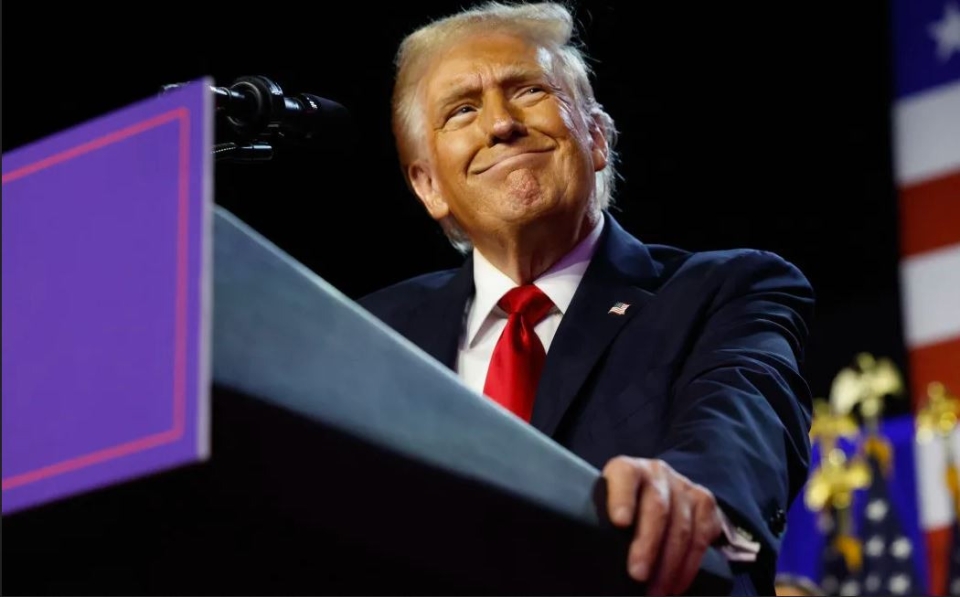
With the arrival of the new calendar year, an opportunity has emerged to reassess international politics over the past year—particularly the positions and highly controversial decisions of the President of the United States, Donald Trump. In 2025, Trump officially took the oath of office as the new helmsman of the United States. His performance throughout that year, along with his most unusual and deceptive decisions, can be examined across two primary dimensions: foreign policy and domestic policy.
- Foreign Policy Failures
In one of his earliest and most glaring foreign policy blunders, Trump falsely claimed that Spain had joined the BRICS bloc, despite the fact that Spain is not a member of this group. Many analysts argue that such verbal mistakes have psychological and cognitive roots, often reflecting mental disorder or confusion on the part of the speaker. In Trump’s second administration, his core foreign policy approach has centered on intensifying pressure on NATO members to increase their financial contributions toward the militarization of Europe. His misstatement regarding Spain can therefore be interpreted as a window into his broader strategic mindset toward European countries.
Similarly bizarre was Trump’s stance toward Canada, which he openly suggested should “return” to the United States and become one of its provinces. His remarks concerning the Panama Canal followed the same pattern. In one of his most controversial speeches, Trump described this strategic waterway as territory that should fall under U.S. control.
In 2025, Trump escalated tensions in West Asia through costly and high-risk actions. His statements regarding Iran—particularly following the U.S. attack on the country—repeatedly included the claim that American forces had destroyed Iran’s nuclear facilities. These claims were later denied by U.S. security institutions themselves. Trump’s repeated falsehoods and bizarre rhetoric concerning countries in the region largely stem from his failure to comprehend the complexity of foreign policy dynamics.
The attack on Yemeni forces, which occurred after one of Trump’s infamous speeches, resulted in significant damage to U.S. naval assets inflicted by the Yemeni military. Following these attacks, Trump paradoxically praised the bravery of Yemeni fighters—an embarrassing contradiction that further exposed his incoherent leadership.
Trump’s rhetorical inconsistencies throughout the past year became a focal point for even Western media outlets. After the Zionist regime’s attack on Qatar, the strategic relationship between Arab states and the United States faced serious strain. Trump failed to uphold America’s security guarantees to its Arab partners. His unwavering support for the Zionist regime effectively signaled a departure from long-standing strategic relations with Arab countries—an approach that will carry serious consequences for U.S. influence in the region.
In pursuing his strategy over the past year, Trump showed little restraint even toward traditional allies. By reigniting disputes over trade tariffs, he generated widespread insecurity among countries aligned with Washington. His remarks about U.S. ownership of Greenland further poisoned relations with the European Union. Such actions during the first year of his second term reflect profound intellectual chaos. Trump appears fundamentally unaware of how a U.S. president is expected to behave, recklessly ignoring the butterfly effects of his own speeches.
- Domestic Policy Deception
Trump returned to power on promises of reducing inflation, lowering energy costs, and slashing pharmaceutical prices in the United States. Yet none of these pledges materialized. Western media outlets reported that gasoline prices in the U.S. climbed to over two dollars per gallon—an outcome widely attributed to Trump’s deceptive promises. His claim of a 1,500 percent reduction in drug prices, made just weeks ago, was another outright falsehood. Inflation, contrary to Trump’s rhetoric, did not decline.
His assertion that food prices had dropped also triggered widespread backlash. In reality, food prices in the United States have not decreased, further exposing Trump’s lack of honesty in public discourse. Trump was also morally condemned by American public opinion over the Epstein case. Despite his insistence that he had no involvement, explicit photographs of Trump alongside Epstein surfaced, solidifying his reputation among U.S. citizens as a habitual liar.
Conclusion
Ultimately, Trump’s approach in his second presidential term represents a distorted blend of America’s historical past—an era when the United States wielded power effectively and could advance its objectives through calculated policy. However, Trump’s delusions of omniscience and deep-seated narcissism are set to complicate America’s unresolved challenges even further. In the years ahead, divisions between the United States and its allies will continue to widen, as Trump’s reckless decisions deepen existing rifts and accelerate Washington’s strategic decline.
Translated by Ashraf Hemmati from the original Persian article written by Amirali Yeganeh