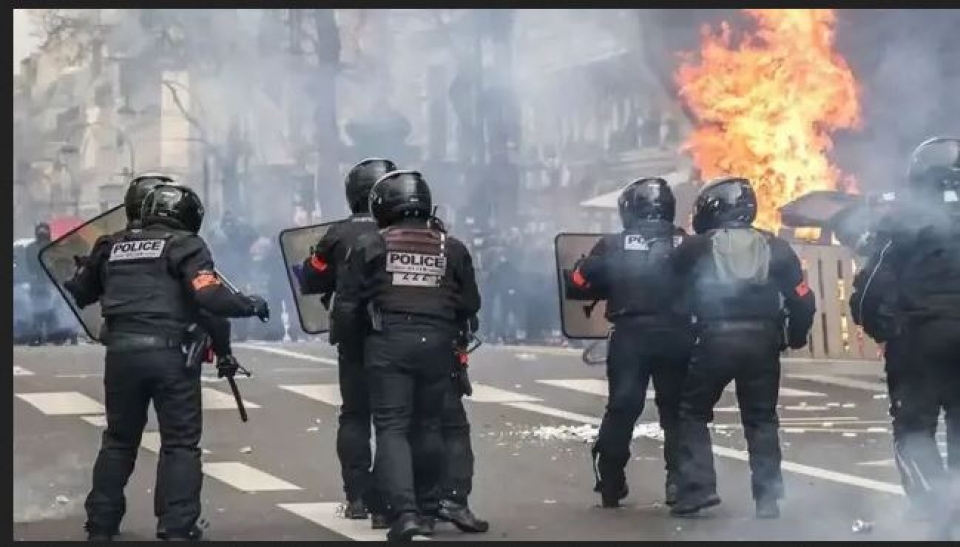
Within Europe’s political architecture, economic protests and labor strikes are not anomalies; they are institutionalized mechanisms designed to preserve the system itself. Contrary to popular perception, these protest movements are not indicators of systemic weakness or imminent collapse. Rather, they function as key instruments for redistributing capital within the inherently contradictory structure of liberal Europe.
These protests are defined and contained within the legal and institutional frameworks of European governments and form a central pillar of “social dialogue.” In this context, one can examine the recurring unrest in France, the continent-wide protests by European farmers stretching from Brussels to Berlin, or the widespread sectoral strikes across the United Kingdom. Such actions are not framed as security crises aimed at overthrowing the political order. Instead, they are interpreted by the system as democratic processes—managed, regulated, and notably free from the need for iron-fisted security interventions.
In European states, economic protests are a constant and normalized phenomenon, rarely escalating into security emergencies. France offers a textbook example. Protest has become an integral part of daily life across the continent. Public opposition—often rooted in class conflict and unequal resource distribution—is embedded within Europe’s institutional democratic mechanisms for expressing demands. Calls for strikes and demonstrations function as legitimate bargaining tools to extract concessions from employers or the state.
What truly distinguishes European protests is not their frequency, but their execution and legal infrastructure. Labor unions announce strikes and demonstrations well in advance; protest routes are predefined and conducted under police supervision. This reflects a deliberate “engineering of anger” within Europe’s political systems. Within this framework, dialogue and controlled civic pressure are formally accepted by governments as functional tools.
At their core, protesters are seeking to preserve living standards and purchasing power. Union-led protest formats aim to reduce structural contradictions in wealth distribution across European societies. Labor and professional unions play a pivotal role here. Far from being disruptive forces, they operate as institutional safety valves for the ruling order. By managing public anger and translating it into negotiable economic demands, unions prevent crises from spiraling out of control.
By converting raw discontent into structured, negotiable claims, unions enable governments and capital holders to engage in bargaining within the system’s own parameters. The aftermath of the widespread European farmers’ protests—where the EU retreated from parts of its regulatory agenda—illustrates this dynamic clearly. Within this model, unions actively prevent protests from slipping outside legal boundaries or transforming into outright rebellion, knowing full well that such a shift would erode their bargaining power—an outcome detrimental to both unions and their members.
Equally important is Europe’s cultural acceptance of street protest. In European political thought, the street is often regarded as the “third pillar of parliament.” It is taken seriously because it is perceived as serving the long-term interests of political stability and systemic survival. This perspective has allowed street protest to function as a legal corrective tool—a feedback loop for lawmakers, signaling when policy overreach has gone too far.
Policymakers are thus confronted with a pragmatic question: is the political cost worth it? In this environment, decisions are recalibrated, excesses are trimmed, and outcomes are adjusted to maximize mutual benefit. Effective protest management and the mediating role of unions prevent economic demonstrations from mutating into riots or causing structural damage. Even during periods of acute economic tension, protests remain largely peaceful instruments through which society articulates its views openly and legally—without inflicting foundational harm on social or political structures.
In this sense, civil protest can be viewed as a marker of social and political maturity within European countries.
Therefore, economic protests in Europe are not treated as security threats. They are institutionalized, routine components of interaction among the state, the market, and civil society. Peaceful, legal, and union-coordinated protests play a significant role in adjusting economic policy. These movements are designed less to dismantle the social order than to preserve and refine it in pursuit of maximum systemic benefit. Consequently, economic protests in Europe function as legitimate policy instruments rather than threats to national security or political stability—successfully embedded into the governmental and social culture of Western states.
Translated by Ashraf Hemmati from the original Persian article written by Mohammad Mehdi Esmail Khanian
Belgium's Workers Rise against Austerity as Government Doubles Down on Cuts Under neoliberal fire, the right to strike is waning, globally, after years of premeditated attacks to limit it - Equal Times