Europe’s decline is no longer a subject unknown to—or denied by—European leaders. On the contrary, it appears that after years of hesitation, they have entered a phase of acceptance. This decline, however, should not be simplistically equated with the rise of Europe’s competitors, such as China and the United States. If Europe intends to move beyond this phase and accelerate its return to the top tier of the international system, it must undergo profound transformations and abandon long-standing principles whose expiration date has long passed.
The most fundamental driver of Europe’s decline is economic. Economic growth in the European Union has been significantly slower than that of its rivals and even its allies. Over the past two decades, the EU has failed to achieve meaningful economic momentum or present itself as a global economic leader. Even Germany—the traditional engine of Europe’s economy—has slipped into stagnation and fallen behind its competitors.
Several factors explain this underperformance, chief among them Europe’s rigid commitment to fiscal discipline and austerity policies. This hardline adherence to principles increasingly obsolete in today’s world has curtailed investment in infrastructure and cutting-edge technologies, leaving Europe trailing behind others. The outcome has been sluggish growth and growing technological dependence on external actors, particularly the United States.
This economic stagnation and prolonged austerity have also produced an indirect yet profound consequence: demographic decline. Slower population growth has reduced the active labor force, forcing cuts to welfare programs, fueling public dissatisfaction, and accelerating the rise of extremist movements—trends that now pose serious challenges to the cohesion of the European Union itself. Austerity has reshaped everyday life across Europe, underscoring its long-term inefficacy. Over the next two decades, Europe will face a shrinking workforce, a growing retired population, and declining productive revenues. Without strategic economic reform, Europe risks losing not only global relevance but even its status as a regional power.
Beyond economics, Europe is under intense geopolitical pressure. Its reliance on the United States for security and on China for supply chains constitutes one of its most critical strategic vulnerabilities. If Europe wishes to remain a meaningful actor in an emerging multipolar order, it must reduce these dependencies and diversify its partnerships.
Europe’s near-total dependence on the United States in security and defense was laid bare during the Ukraine war. Today, European states must redefine the rules governing their defense industries and address long-standing structural weaknesses in order to compensate for military shortcomings and engage the United States from a position of parity. Washington has proven adept at leveraging Europe’s vulnerabilities to strengthen its own economy and growth trajectory—making it clear that the era of “free rides” for Europe is over. Strengthening Europe’s military and defense capacity is no longer optional; it is essential to arrest further strategic decline.
At the same time, Europe remains heavily dependent on China within global supply chains—a dependence that has made it particularly vulnerable amid the US–China trade conflict. Europe must avoid a binary, zero-sum approach toward China and instead pursue an engagement-based strategy rooted in shared interests. Only through diversified engagement can Europe reduce excessive reliance on China. Cooperation with Beijing in financial sectors and the transition toward green energy can be both practical and beneficial.
However, Europe must also recognize that global norms are no longer defined solely by Western or European moral frameworks. Persistent moral lecturing and the use of double standards in human rights discourse as political leverage will only hinder constructive engagement with countries like China.
Ultimately, Europe stands in need of a comprehensive strategic reassessment—a true paradigm shift. Domestic and foreign policies must be brought into alignment through a coherent, long-term strategy. This strategy should prioritize investment in infrastructure and the transition to green energy—sectors where Europe can still shape the future. Equally important is achieving internal unity, which requires persuading national governments and, crucially, public opinion. Without popular support, no strategic initiative can succeed.
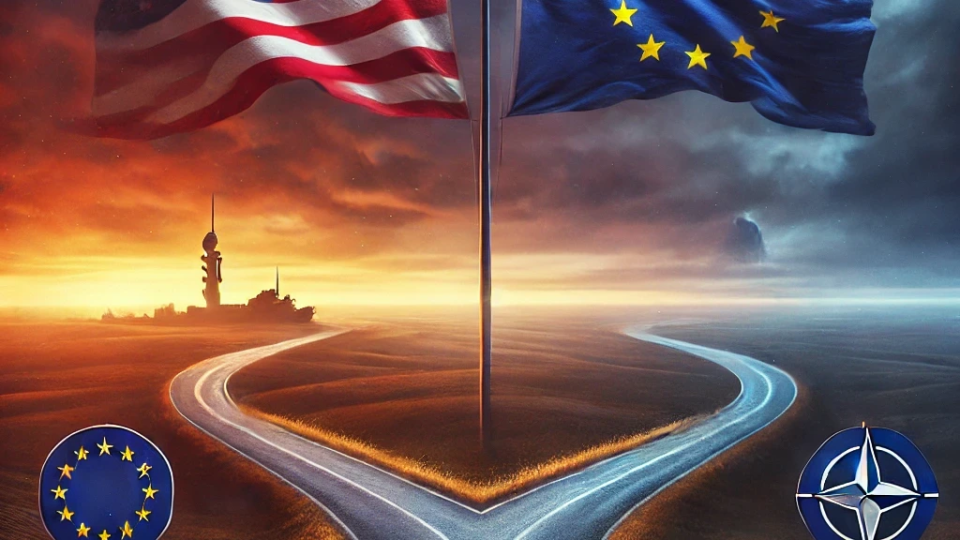
In foreign policy, Europe faces a defining choice: will it continue down the path of uncritical alignment with the United States, accepting the role of a subordinate partner, or will it attempt to act as an independent power within the international system? The answer to this question will determine where Europe ultimately stands in the global order of the near future.
Translated by Ashraf Hemmati from the original Persian article written by Amin Mahdavi
https://www.nytimes.com/2025/12/16/opinion/europe-decline-economy-china.html Defending Europe with less America – European Council on Foreign Relations bruegel.org/policy-brief/strategy-doctrine-next-steps-european-economic-security