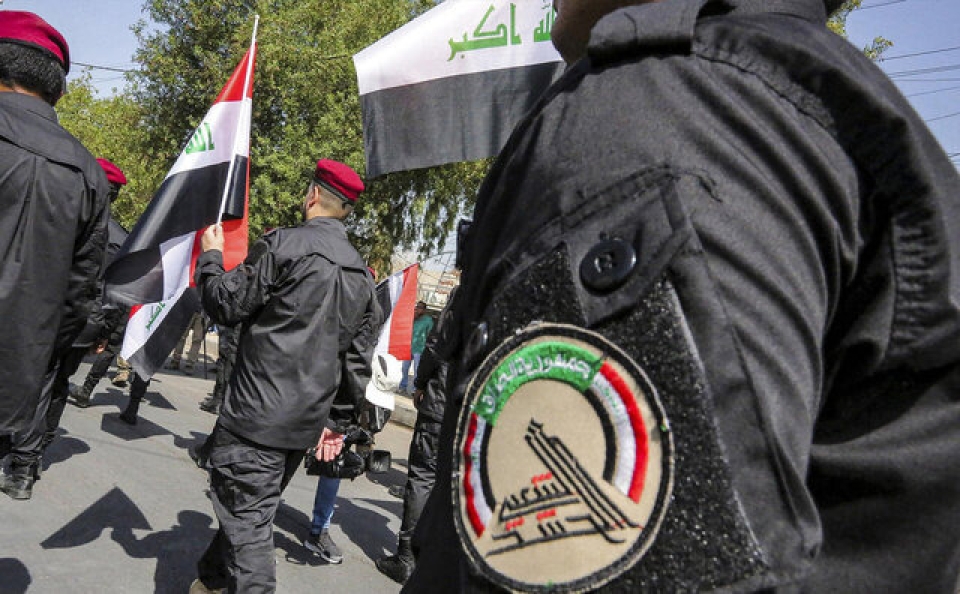
On Saturday, Iraq’s highest judicial authority announced that the leaders of several armed factions had agreed to cooperate on the sensitive issue of confining weapons exclusively to the state. Some actors inside and outside Iraq have sought to portray this decision as a surrender to US pressure and Israeli threats, arguing that it coincides with regional pressures and attacks aimed at forcing resistance forces—particularly in Lebanon—to disarm. This article examines the broader dynamics behind this development.
The factions that have agreed to hand over their weapons include Kataib Sayyid al-Shuhada, Harakat Ansarallah al-Awfiya, Kataib Imam Ali, the Badr Organization, and Asaib Ahl al-Haq. While the mechanisms and timeline for disarmament have not yet been officially announced, Iraqi officials view the move as a potentially decisive step toward restoring the state’s monopoly over armed force.
Qais al-Khazali, leader of Asaib Ahl al-Haq—which secured 27 seats in the most recent parliamentary elections—stated: “We believe in the slogan of limiting weapons to the state… we are now part of the government.” Two other groups, Harakat Ansarallah al-Awfiya and Kataib Imam Ali, likewise declared that the time has come to confine weapons to state authority.
However, the powerful Kataib Hezbollah has stated that it will only discuss disarmament once all foreign forces leave Iraq. In a statement, the group emphasized: “Resistance is a right, and its weapons will remain in the hands of its fighters.” In the same vein, Dr. Firas al-Yasser, a member of Harakat al-Nujaba’s political council, argued that the weapons of the resistance are not “unregulated arms,” but rather “weapons of dignity,” adding that an army constrained by US interference cannot alone protect Iraq from occupation and terrorism.
In practice, both Kataib Hezbollah and Harakat al-Nujaba have conditioned any handover of their weapons on the complete withdrawal of foreign forces from Iraq, including US-led coalition troops and Turkish forces.
Yet there is no national consensus in Iraq on how such a withdrawal—particularly of US forces—should be implemented. Even factions that have tied disarmament to a US withdrawal are not currently engaged in direct confrontation with American forces, largely because they are awaiting the implementation of an agreement between Baghdad and Washington that envisions a gradual withdrawal of occupation forces by the end of 2026. Still, some of these groups view the United States as deceptive and believe it is seeking to maintain a long-term presence in Iraq through political maneuvering. This skepticism is a key reason why groups such as Kataib Hezbollah and Harakat al-Nujaba continue to refuse disarmament.
Previous efforts by Iraqi governments to regulate or integrate armed factions have also faced significant obstacles, including disputes over trust, guarantees, and the role of state institutions in managing the process. Although some factions have agreed in principle to hand over their weapons, reports suggest they are seeking assurances regarding their political future, legal status, and protection from external threats.
This shift toward arms monopoly comes at a particularly sensitive moment for Iraq. In recent months, Baghdad has sought to prevent the country from becoming an arena for regional confrontation. These concerns, combined with economic pressures and security obligations, appear to have reshaped the internal calculations of Iraqi armed groups.
From another perspective, the decision by armed factions to disarm could facilitate the formation of a future government in line with electoral outcomes. It may also allow groups previously excluded from government participation—due to their armed status and US opposition—to enter the political process and pursue their objectives through institutional channels. This is especially relevant given that disarmament would necessitate the integration of these groups’ forces into Iraq’s official security apparatus.
It is also important to note that disarmament does not entail the dissolution of the Popular Mobilization Forces (PMF), which constitute an official security body and one of Iraq’s recognized defense pillars alongside the national army. That said, the PMF’s future missions may be more clearly defined in later stages, particularly as a related legislative proposal remains stalled in parliament due to political divisions and US pressure.
Ultimately, achieving a monopoly of arms could strengthen internal security, enhance state cohesion, and reduce the influence of external actors in Iraq. At the same time, the significant role and sacrifices of armed groups in preserving Iraq’s territorial integrity must be acknowledged. Their concerns regarding the continued presence of US forces should be taken seriously, and concrete planning for the withdrawal of American advisers and other foreign troops is essential. Iraq can only meaningfully reorganize and consolidate its security institutions once foreign—especially US—forces have left the country.
Translated by Ashraf Hemmati from the original Persian article written by Hakimeh Zaeimbashi
- https://www.al-akhbar.com/arab/872861
- https://www.iraqinews.com/iraq/iraqi-armed-factions-hand-over-weapons-government/?utm_source=chatgpt.com
- https://www.newarab.com/news/iraq-top-judge-says-armed-factions-cooperate-weapons?amp=&utm_source=chatgpt.com
- x: @alnujaba
- https://www.al-akhbar.com/arab/872861
- https://www.iraqinews.com/iraq/iraqi-armed-factions-hand-over-weapons-government/?utm_source=chatgpt.com 7. https://www.al-akhbar.com/arab/872861